

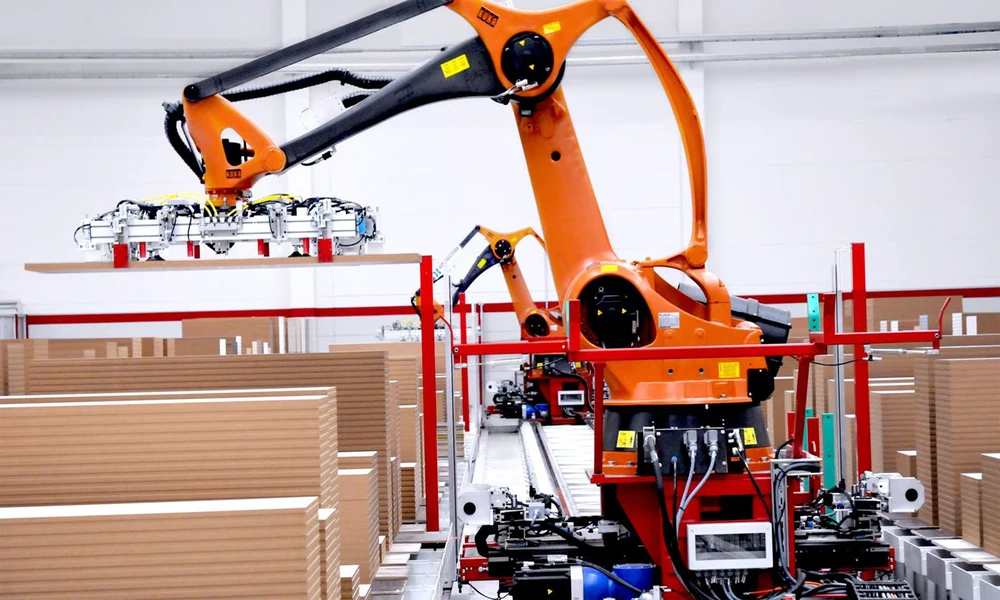
Businesses shipping bulk liquid or semi-liquid products in Singapore eventually reach a volume where filling individual containers one at a time, even with an automated single-station machine, can’t keep pace with order volume. At that point, the conversation shifts toward pallet-scale filling systems, which handle multiple containers simultaneously or move filled containers directly into palletized formation as part of the same automated sequence. This guide walks through what an automatic pallet filler actually does, the container types it typically handles, and the practical considerations that matter most when specifying one for a Singapore facility.
Defining Pallet Filling in a Singapore Context
The phrase pallet filler covers more than one type of system, and the ambiguity causes confusion during vendor conversations. Some systems fill multiple containers arranged on a pallet simultaneously through a manifold of fill heads, which suits operations running identical containers at high volume. Others fill containers individually further up the line and then palletize them automatically once filled and capped, integrating filling with end-of-line logistics rather than combining the fill step itself. A Singapore-based operation should clarify early in vendor discussions which configuration a proposed system actually uses, since the two approaches differ substantially in cost, footprint, and flexibility, and a vendor’s marketing material doesn’t always make the distinction clear.
Container Types That Move Through a Pallet Filler
Pallet-scale filling systems in this region typically handle jerry cans, pails, and drums arranged in standard pallet configurations, since these formats lend themselves to grouped handling and stack reliably during warehouse storage and export shipping. The container type in use affects manifold spacing, nozzle design, and how the system indexes containers into and out of the fill zone. A system built around 20-litre jerry cans arranged four to a layer won’t necessarily adapt to 25-litre pails without mechanical adjustment, so businesses running mixed container types across different product lines need to confirm changeover procedures during the evaluation stage rather than assuming a single configuration will handle everything the plant produces.
Throughput Planning for Bulk Output
Specifying a pallet filler starts with an honest assessment of actual order volume rather than aspirational figures, since oversizing a system wastes capital and floor space while undersizing one recreates the bottleneck the investment was meant to solve. Businesses should look at peak order periods rather than average monthly volume, since a system sized for average demand will fall behind during seasonal spikes that many bulk liquid businesses experience around specific times of year. It also helps to model how the filling stage interacts with upstream production capacity, since a pallet filler that can process containers faster than the plant’s mixing or blending equipment can supply product simply sits idle waiting for feedstock, which defeats the purpose of the investment.
Footprint Considerations in Land-Scarce Facilities
Pallet-scale filling equipment occupies considerably more floor area than a single-station filler, and in Singapore’s industrial estates, where rental rates and available floor space both run tighter than in many other manufacturing hubs, this footprint has a direct cost implication. Businesses evaluating pallet filling systems suited to local facility layouts need to account not just for the machine’s physical dimensions but for the clearance required around it for forklift access, pallet staging, and maintenance work. A system that fits on paper but leaves no room for a forklift to maneuver safely around a staged pallet creates an operational hazard rather than an efficiency gain, so floor plan review should happen before equipment selection rather than after.
Choosing Between Semi-Automatic and Fully Automatic Systems
Fully automatic pallet fillers handle container indexing, filling, and often capping with minimal operator intervention, while semi-automatic systems still require staff to load empty containers or trigger fill cycles manually even though the dosing itself is automated. The right choice depends less on budget alone and more on production volume, available labor, and how much variability the plant expects in container type or fill volume over time. A semi-automatic system often makes more sense for a business running several different products through the same line, since operators can adjust settings between runs more easily than reprogramming a fully automatic system’s control logic for every changeover.
Questions to Ask Before Committing to a System
Before finalizing a pallet filler purchase, a business should confirm expected fill accuracy tolerances, average changeover time between container formats, the availability of local technical support, and how the system integrates with existing conveyor and palletizing equipment already on the floor. It’s also worth asking a prospective supplier for a demonstration using the actual product to be filled, since viscosity and foaming characteristics that look manageable on a datasheet sometimes behave differently in practice. These questions matter more than headline throughput figures, because a system that can’t hold its rated accuracy on the specific product involved won’t deliver the efficiency the purchase was meant to achieve, regardless of how fast it runs on paper.
Automatic pallet filling represents a significant step up in both capability and cost compared with single-station filling equipment, and the decision to invest in one should follow directly from measured production volume rather than a general sense that the plant has outgrown manual methods. Singapore manufacturers weighing this investment benefit from working through container format, throughput requirements, and floor space constraints methodically before approaching vendors, since walking into that conversation with clear requirements produces a far more useful proposal than asking a supplier to recommend a system from a blank starting point.
